
Straight answers, sorted by where the stone is.
Grouped by the surface you are standing at, so the answer is quick to find.
On the floor
The surface that gets walked on, mopped, and judged from the doorway.
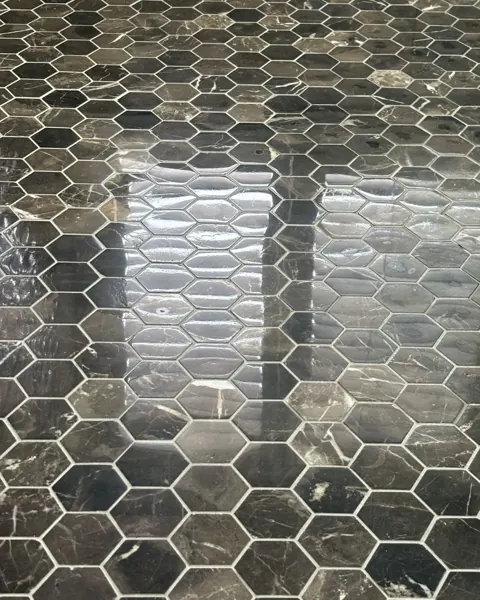
Why is the floor hazy after mopping?Four causes, one of which is the mop itself. Only one comes out with more cleaning.3 min Seven signs a stone floor needs more than a clean.Dull after cleaning is the first one. The other six follow it, and the earlier you act the less has to come off.3 min A marble floor restoration, start to finish.Diagnose, protect, clean, level only if it needs it, hone, polish, repair, seal. Not every floor needs every step.3 min Scratches on a marble floor: light, deep, and what each takes.If you cannot feel it, it hones out. If a nail catches, it needs grinding first. Either way the whole area is done, not the spot.2 min Polished, honed or satin: which finish for a marble floor?Polished shows everything and rewards care. Honed hides daily wear. Satin sits between. None of them is a coating.3 min Honing, polishing and grinding: what each one takes off.Grinding levels, honing corrects, polishing reflects. The right job uses the least of the three that fully fixes the fault.3 min Looking after a stone floor that a building walks through all day.The floor declines in stages, and the cleaning contract is usually what pushes it through them. A plan costs less than a rescue.3 min Five habits that wreck stone, and five that keep it.Vinegar, an unsealed bench, a scouring pad, waiting, and a repair kit. The good habits are cheaper than any of them.2 min
On the benchtop and the table
The surfaces that meet lemons, wine, hot pans and every cleaner under the sink.
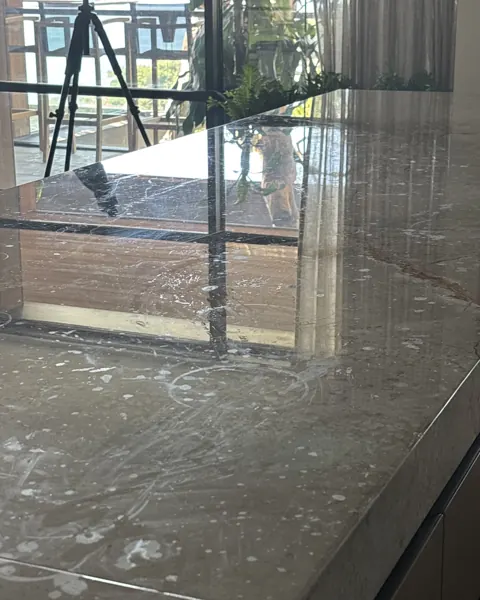
What actually damages a marble benchtop.Acid, grit, oil and time, in that order of frequency. Most of it comes out in place, and the first one is the only one you cannot seal against.3 min Benchtop polishing: what the service actually does.It corrects the surface, it does not coat it. Scratches and etching are honed out, the top is polished as one piece, then sealed.2 min The right sealer for a marble benchtop, and what it will not do.A penetrating sealer, applied to a clean, corrected surface. It slows stains. It does nothing for etching, and no sealer does.3 min Does polishing take a stain out?If it is an etch, yes, completely. If it is a true stain, polishing makes it shinier. A poultice comes first, and some stains stay.3 min Polishing a marble table top.Diagnose before you buy anything. Residue cleans off; etching and scratches are honed out; the table is done in the room.2 min
In the bathroom
Water drying on stone every day, and the sprays sold to clean it.
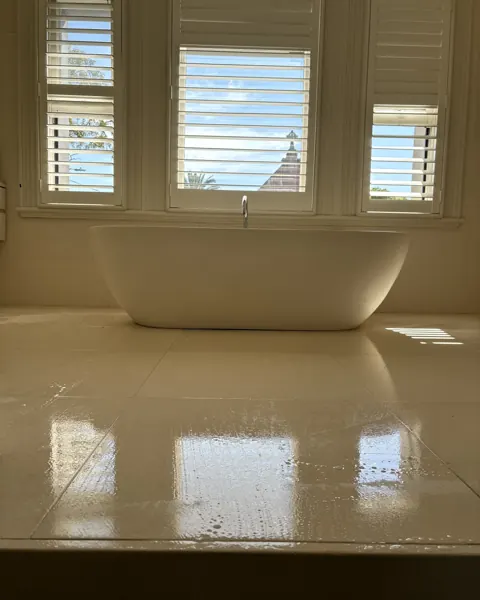
A dull marble vanity: what you can do, and what needs us.Residue cleans off. Etching from toothpaste, soap and sprays does not; it is honed and polished, and sealing alone will not fix it.2 min Stone showers: why they cloud, and how they come back.Soap film and minerals clean off. Etching from bathroom sprays is honed out. The floor stays honed for grip, and only the walls take a polish.2 min Watermarks on marble: which kind you have, and how to stop them.A shadow dries out. A chalky ring is minerals and strips off. A dull ring is an etch and is honed. Only the last one is damage.2 min Tile haze: grout film, cleaner film, or etching.On porcelain, a haze remover and a thorough rinse. On marble or limestone, never an acid: the haze comes off with stone-safe cleaning or a light hone.2 min
Sealing
What a sealer does, what it never does, and how often it is needed.
Sealed or unsealed: what a sealer actually protects.Sealing slows stains; it never stops etching. Worth it on travertine, limestone, honed marble and grout. Wrong as a first move on a damaged surface.2 min How often should marble be sealed?When the water test says so. Kitchens and showers about yearly, quiet floors two years or more, and never as a fix for etching.2 min How stone is sealed, step by step.Clean, correct, dry, then a thin coat of the right penetrating sealer with the excess wiped off. Sealing is the last step of a restoration, never a substitute for one.2 min Sealers, enhancers and coatings: which is which.Penetrating sealers for almost everything indoors. Enhancers only where you want the wet look forever. Coatings almost never on natural stone.2 min
Damage, repairs and replacement
Etching, stains, chips and the decision that costs most when it is guessed.
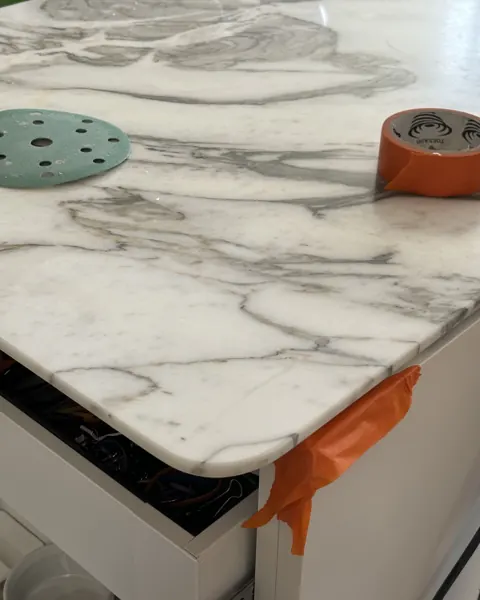
Etching: what it is, what causes it, and how it comes out.Acid has dissolved the polish. Nothing is on the stone, so nothing wipes off. It is honed away and polished back, on marble and limestone alike.3 min Can stained marble be restored?Usually. Oil and organic stains draw out with a poultice; rust and dye may lighten rather than vanish; and half of what is called a stain is an etch.3 min Dull marble: why it goes flat, and how it comes back.Clean it first and look again. What is still dull is in the stone, and comes back with honing and polishing, not with wax.2 min Chip repair: what to look for, and what a good one looks like.Colour-matched, rebuilt to the edge profile, levelled and polished with the surface. Discreet at standing height, not invisible up close on veined stone.3 min Epoxy or stone filler: what a chip repair is made of.Epoxy for depth, strength and colour. Filler for shallow pits and travertine holes. Either one shows if the finishing after it is skipped.3 min Polish it or replace it?If the stone is sound, restore it. Replacement is for structural failure, and it costs more, takes longer and does not always look better.3 min
The other materials
Terrazzo, grout, porcelain, limestone and travertine, and how the three calcium stones differ.
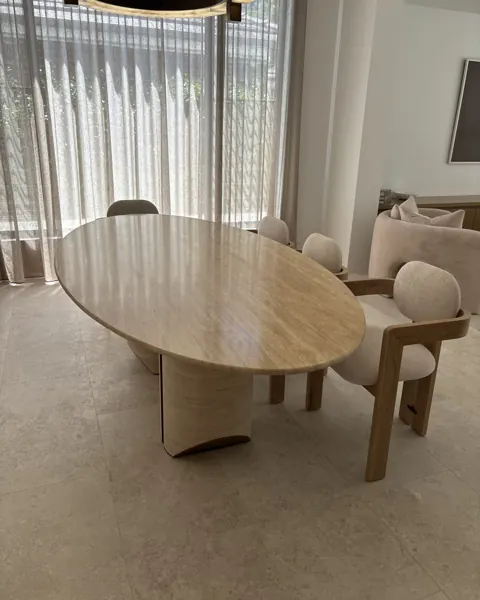
Marble, limestone and travertine: the differences that matter.One chemistry, three structures. All three etch; travertine and limestone drink more; marble polishes hardest. Which one you have decides the finish, the sealer and the fix.2 min Cleaning limestone without harming it.Dust it, damp-mop it with a neutral cleaner, dry it. Nothing acidic, nothing abrasive, not much water. If it looks chalky or cloudy afterwards, the cleaner was wrong.2 min Travertine floors: filling, honing, cracks, and when a tile is replaced.Holes are refilled and honed flush. A stable crack is bonded, filled to colour and refinished with the floor. A moving one is a substrate problem first.2 min Terrazzo: repair, polishing and getting the shine back.Strip the coatings, match the chips to the aggregate, grind only if it needs levelling, hone, polish to the sheen the room wants, seal. No acid, ever, on a cement binder.3 min Grout beside stone: cleaning it without etching the marble.Grout and the stone next to it are one surface. Neutral cleaner, soft brush, thorough rinse; repair or colour-seal what cleaning cannot fix; never bleach or acid near marble.2 min Porcelain tile and grout: deep clean, or restoration.The tile is fine; the film on it and the soil in the grout are the problem. Extraction, not stronger soap. Seal the grout, not the porcelain.2 min